3D printing is a form of additive manufacturing, where the material is added in successive layers to build up a 3-dimensional form from various materials. Its history is mired in one of the more contentious processes of the American legal system, the intellectual property patent. In the 1980’s and 1990’s patents were processed to market the profitability of 3D printing and its subsequent processes. Access to printers became expensive and the technology stalled commercially until the patents expired. Since 2010 the 3D printing process has boomed with many contributions being supported by developers, educational institutions, and STEM fields. Open source software and hardware has enabled rapid advances in 3D printing to where it is now commercially viable as a product.
Currently there is support for 3D printing from schools, colleges, technology fields, and manufacturing. It spans STEM fields, such as math and engineering, to applications in aerospace, bio-engineering, and medicine. It is a process that is considered an emergent technology. For learners and teachers, this means an opportunity within the classroom to apply, prototype, and model formulas, equations, and structures in 3 dimensions to support class experiences. Technical literacies such as coding, computer aided design(CAD), and manufacturing technology are in demand for 21st century employment.
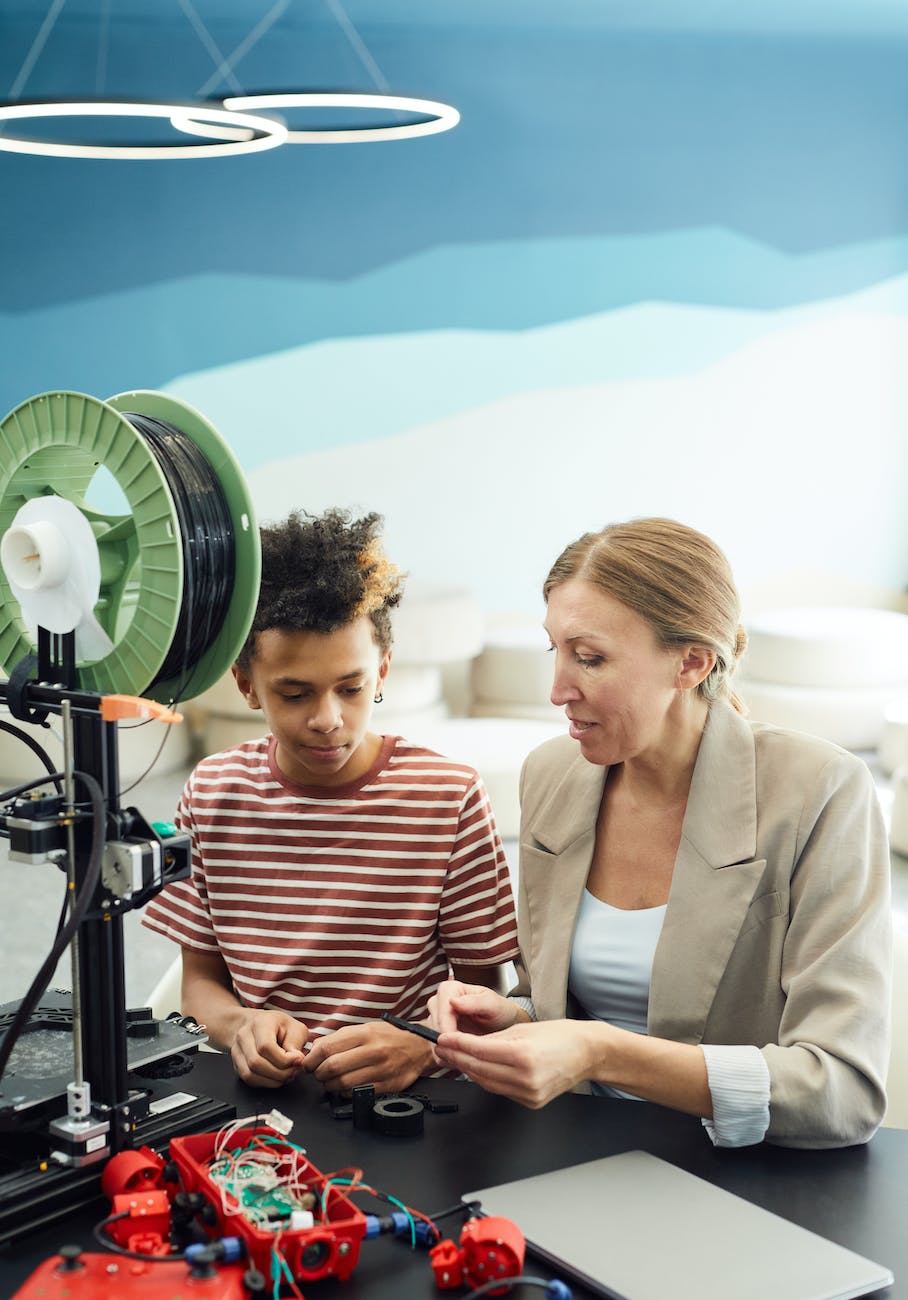
As a tool for learning, 3D printers can benefit every classroom. Diverse classroom populations, including often overlooked genders, races, and second language learners, can benefit from technology that encourages collaboration and communication of groups with different cultural worldviews. 3D printed objects bring an immediate and tangible resource to science, math, language, and art classes by providing examples for students to feel as well as see in three dimensions.
Today, a 3D printer is as easy to operate as any modern appliance. Mechanically reliable and intuitive, the code is generated by many software applications for a variety of ages and skill levels. Another hallmark of the 3D printing revolution in education is the vast network of learning communities that provide instruction, help, and libraries of pre-made CAD models for teachers and students to use. The excitement students have when watching a 3D printer work captures their attention and focus on STEM fields as attainable goals.
 Marcus Szeiman
Leave a comment